Monday, July 6, 2009

Culture Shock

One of the challenges of travel is adjusting to a different culture. In the process, one becomes more aware of the nature of one's own culture as things that had been transparent -- taken for granted -- become opaque.

The greatest "culture shock" of my pilgrimage so far has occurred Sunday morning as the Calvin 500 conference began. The conference is a key event in my sabbatical plan, taking place over the five days leading up to the quincentenary celebration of Calvin's birth on July 10. To add to the significance of the conference, it takes place at St. Pierre Cathedral, where Calvin preached, and the adjoining Auditoire where he taught during his Geneva ministry.

The first shock was when I arrived for worship way underdressed. I was wearing dress pants and a clean, unwrinkled shirt, but I found myself in a sanctuary filled with suits and dresses, all sporting "Calvin 500" badges. These were nearly all American Presbyterians coming to worship while on vacation. Unlike me, they have been part of the "official tour" for the preceding five days or so. I skipped the tour and signed up only for the conference. It was clear that while we shared a native land, we didn't share the same cultural expectations of worship (or travel).

Then, as worship began, a second wave of culture shock hit me. All of the leadership of the service, including all of the ushers receiving the "collection" were male. The preacher of the day, also a male, was dressed in a business suit more suitable to the Fortune 500 than the Calvin 500. I would not have been surprised to see a Geneva gown and preaching tabs, but a power suit? It seemed out of place. Then there were other things: instructions to stand (but not just to "those who are able"), lots of Father God language with no effort at inclusive language, and above all, a kind of preaching style that is expository without being exegetical, that confines itself to the theological issues of 19th century (yes, 19th, not 16th) Protestant evangelicalism with a tone of deep moral concern. (How many preachers have to decry the secularism and "immorality" on the streets of Geneva? Where do these people live?)

History tells us that Calvin was buried in an unmarked grave so that his tomb would not become a shrine of devotion, like those of Catholic saints. What I have encountered in my first two days of the Calvin 500 conference is less the spirit of the Calvin who didn't want to canonize the past than that of the church Calvin confronted, mired in a theology and a way of being the church that no longer fit either the times or our best understanding of scripture. Sometimes I feel like shouting down the preacher or walking up to the pulpit (it's about 6 feet off the ground) and taking over the sermon.

Case in point: one of tonights three (yes, three) sermons was on "Calvin's most cherished text": John 17:3, from Christ's "high priestly prayer": "Now this is eternal life; that they may know you, the only true God, and Jesus Christ whom you have sent." It is a provocative text, that invokes John's mystical understanding of "eternal life" (as in John 3:16) and "union in Christ." But did the sermon (by a seminary president, no less) make any effort to place the text in Johannine theology? Did he even try to place its meaning in Calvin's theology? No. Eternal life means the life in heaven after we die. Our purpose is to help people find heaven when they die, according to the preacher. No effort at all to understand what this pre-modern vision of salvation communicates in the 21st century. No effort to correlate Calvin and our day. It wasn't a sermon. It was an exercise in a meaningless language game.

There are times I want to say to them, "Haven't you even read Barth? He's only been published for 90 years, and is the most significant interpreter of Calvin in history." Oh well. there have been a few bright spots, at least. But for the most part, I feel like a tourist in a land where I don't speak the language or know the customs. Culture shock.

Sunday, July 5, 2009

Paris to Strasbourg to Geneva, Part II

The second item I wanted to discuss under this heading deals with my itinerations during my last few days in Paris. The first of these was to Versailles, the magnificent "summer estate" of the Louis XIV, the self-proclaimed "Sun King" of France in the 17th century. Granted, that misses Calvin's time by a few generations, but it does point to the incredible inequalities and injustices of French society in Calvin's time as well.

Versailles is one of humankind's greatest indulgences to the human ego. The king fashioned himself after the Greek sun-god Apollo, placing his
own image in the sculpture of Apollo's chariot emerging from the great fountain in the midst of his extensive gardens. Even the gold-leaf chapel
is less a shrine to Christ than it is a testament to the wealth and ego of the King.

Louis XIV benefitted from the period of relative peace in the religious wars against Protestants following the Edict of Nantes (1598) granting limited tolerance. But a King who fancies himself a god is not going to put up with a religion that is steadfastly opposed to tyranny and idolatry, and he revoked the Edict midway
through his lengthy reign in 1685. There was no massacre as there had been in 1572, but it resulted in the Huguenots leaving France for established Protestant communities in England, the Netherlands, Prussia, and Switzerland, and to North America (including my childhood home town of New Rochelle, New York) and South Africa.

Strasbourg is a noticeable contrast to Versailles. Located in the Alsace region of France, adjoining Germany along the Rhine, Strasbourg experienced extended periods of relative independence
during the formative period of the Reformation. Martin Bucer (author of the French Confession) was a leader of the Reformed churches in Strasbourg when Calvin left Paris intending to settle there. Calvin was sidetracked to Geneva first, but spent three years in Strasbourg between 1538 and 1541 before returning to
Geneva for good.

Strasbourg has a strong Protestant presence. It is a relatively unpretentious but quaint and lovely city that is the home to the new EU Parliament. It boasted the highest church spire in Europe (489 feet) until the 19th century, and the cathedral is impressive without being ostentatious. More impressive to me, however, are the humble churches (Le Bouclier and St. Nicolas) with which Calvin was associated. Both still house congregations, although I don't know if the balcony pulpit at St. Nicolas (rebuilt in the 18th century) is still used.

The contrast between imperial Versailles and modest Strasbourg point out that the origins of Protestantism were as influenced by the socio-economic realities of the era as by the doctrinal disputes. Calvin drafted the "Ecclesiastical Ordinances" while in Strasbourg, which is the foundational document for his writings on church polity. His emphasis on church order which counters the excesses of hierarchy by pairing authority with accountability, and his theme of discipline as an exercise of pastoral care are legacies that have greater resonance today than the imperial cult of the Sun King.

The Calvin 500 conference got underway today. I will share some reflections on that in my next post.

Friday, July 3, 2009

Paris to Strasbourg to Geneva, Part I

Note: Photos have been added to the previous blog post.

It's July 3 and I am now in Geneva. The past week has been overwhelming time-wise, and I have ended each day too tired to blog. Paris has been in a heat-wave, with temps in the upper 80s and high humidity. This has left me with heat rash and mosquito bites. Much of this week has been spent with my daughter Bethany and her boyfriend Kyle Leichter doing more "touristy" activities (Versailles, the Louvre, etc.) However, I am pleased to report on two events more in keeping with the theme of my sabbatical.

The first involves my service at the American Church in Paris. I wrote about this church in a previous post. I was pleased to participate in worship on Sunday June 28 with a full sanctuary of worshipers at one of three worship services that day. During the week I have had extended conversations with Senior Pastor Scott Herr about the church and its ministry, and I led a discussion on "Spirit, Power, and Community: Church Order in the New Testament from a Reformed Perspective" to about 15 church leaders.

The ACP is in many ways what the North American church will be like: increasingly multinational (over 50 nationalities are in the congregation) and struggling to bear a faithful witness in an increasingly secular culture. Like many American churches, however, its leadership has yet to adapt its way of thinking to 21st century realities. 1970s solutions don't fit 2010 problems. We are in need of a new Reformation like the one 500 years ago. That movement addressed the realities of a world turned on its head by a new means of communication: movable type and the mass distribution of the printed word. Our new Reformation must deal with an even more dramatic communication revolution: the instantaneous global communication made possible by the internet, and the resulting deluge of information overload. Combined with the shift from word-based to image-based media, this creates what I call "communication inflation" -- the cheapening of communication by its overproduction and the debasing of words by more emotionally powerful (and easily manipulated) images. The overproduction of communication cheapens all communication, and makes it more difficult to sort out the wheat of meaning from the chaff of trivia and propaganda. These are sea changes in the global culture that will not be undone. It remains to be seen how Christian faith will adapt to these new realities. However, we can anticipate a change on the magnitude of that which happened in the 16th and 17th centuries.

However, there is still much we can learn from the previous reformation. The contributions of Calvin and Knox still ring true. My presentation on church order borrows from the Reformed ecclesiology of Calvin (through Knox). A powerpoint outline can be found here: http://www.plainsandpeaks.org/Default.aspx?tabid=512&DMXModule=1288&Download=inline&mid=1288&EntryId=550.


In my next post I will talk about my visits to Versailles and Strasbourg as part of my pilgrimage.


Friday, June 26, 2009

The Practice of Pilgrimage

Noyon, the birthplace of John Calvin, lies some 50 miles northeast of Paris. It is a city with a long history, situated on the ancient Roman Via Agrippa. Its name comes from the Latin novus magus, roughly translated as "new market" in recognition of its prime location on the Oise River in the breadbasket region of Picardy.

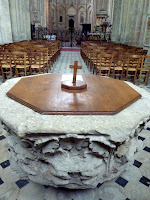
The fertile fields of Picardy have seen more than their share of battles: After the Romans conquered it came the Normans, then Charlemagne. It was a center of activity during the Hundred Years' War, and more recently suffered heavy damage in both World Wars. The first World War saw the town Cathedral (established in the seventh century) suffer catastrophic damage. The home reputed to be Calvin's birthplace also suffered irreparable harm. Both buildings (and much of the rest of the ancient city) were reconstructed to restore the traditional Neo-Gothic style to this quaint village.

Which is all preface to saying that Noyon is a small place with a big past. And I mean small. You can walk every street in town (many of them are historically preserved or restored) in about an hour. There are no public restrooms to be found -- a common problem in Paris as well. I did happen to witness a guy in a park wander over to what I thought were restrooms only to see him urinate on the side of a building. Another aspect of small town life in France is that the entire city, with the exception of restaurants and the cathedral, shuts down between Noon and 2 p.m. Which isn't good when you have left the restaurant and a thunderstorm hits.

But the big past, not the small town, is the reason for the pilgrimage. The cathedral is an impressive religious site in its own right. It hosts a placard listing the name of every presiding priest since St. Medard in the early sixth century. Charlemagne and Hugh Capet are said to have been coronated on that site (in a predecessor building). It hosts (to this day) the baptismal font in which the infant John Calvin was received into the visible church.

But I didn't go there for the cathedral, although it was a pleasant surprise. I didn't even go because of the Musee John Calvin located there (a good thing, since the museum is, to put it mildly, a dud). I went because Noyon is the place where John Calvin was born and raised. His experiences there laid the groundwork for his eventual desire to reform Catholicism.
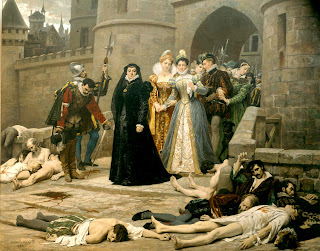
And I learned something about pilgrimages: you don't make them in order to "get something" out of the experience. You make them to bear a witness to the past in order to be a witness for the future. And I bore witness to the miraculous grace of God that can make a John Calvin rise from such a town as this. As it turns out, the Protestant movement in Noyon didn't last past the St. Bartholomew's day massacre less than a decade after Calvin's death. In my tour of the city, I could not find a single Protestant church today.

Noyon has many things of which to be proud in its historic past, the birth of John Calvin among them. But to judge by the town today, I think they wouldn't put Calvin's birth at the top of the list. I would. And I went. And I witnessed. And that's what it's all about.

Thursday, June 25, 2009

The Site of the Martyrs

I write this post from the American Church in Paris, my hosts for the next eight days or so. The church is on an important historical site. When the infamous St. Bartholomew's Day massacre occurred in August 1572, thousands of French Huguenots (Reformed Protestants) were slaughtered. The massacre began on the East side of the Louvre, then the palace of Charles IX, whose sister had just married Henri of Navarre, a Protestant. The king's mother was Catherine de Medici, a staunch Roman Catholic whose native land had become embroiled in ongoing battles between Catholics and Protestants. She found the marriage to a Protestant unacceptable, and had been advised that since the Huguenots had all gathered to celebrate the marriage of a royal to a Protestant, it would be easier to pre-empt any potential uprising by massacring them then and there. A signal was issued (a small bell, rung by Catherine, and repeated by the church bells of St. Germain l'Auxerrois) and the killing began. Most of the killings happened by the river, and the bodies began washing ashore downstream, on the site of what is now the American Church. The church is literally built upon the witness of the martyrs.

This morning, my host, the Rev. Dr. Scott Herr, shared with me the stories of the early struggles of the Protestant community in Paris as we traveled to St. Germain des Pres (a different church than St. Germain l'Auxerrois), where the Protestant reformation in Paris began. In the abbey of this, the oldest church building in France -- dating to the sixth century -- Jacques Lefevre translated the Bible from ancient Greek manuscripts. The discrepancies between them and the Latin Vulgate moved him to support the nascent reformation movement. Among his pupils was William Farel, who influenced Calvin to reform the Geneva church, and it is said he was visited by Calvin himself on Calvin's flight from France.

The nearby area became a Protestant neighborhood, and the first
synod was organized to perform Protestant baptisms at No. 4, Rue des Marais, situated over catacombs that were thought to give them protection from a possible raid. The site is now an art gallery, and the owner graciously allowed us to go downstairs to where the baptisms took place. I am amazed it isn't recognized as a historical site here.

I am still processing my thoughts and feelings about this introduction to the history around me. I am reminded about what my friend and colleague Bill Chapman wrote about the Book of Order, that "it has blood on every page." In this case, however, the blood is real, and the witness of the martyrs lives on. The oppression of Protestants in Paris, and France generally, led Calvin to seek a safer place to live -- which, by Providence and William Farel's persuasion, was Geneva. However, the expatriate French Protestants in Geneva never were far from their brothers and sisters in France, and Calvin and the Geneva Council designated as much as one-fourth of the offerings of the Geneva Church to their support.

Tomorrow, I visit the birthplace of Calvin in Noyon. Thunderstorms are forecast.


Sunday, June 21, 2009

It's Been a While...


It's been a while since my last post. I have been mixing rest, study, family responsibilities, and trip preparation over the last two weeks. I enjoyed several very productive study days at Highlands Presbyterian Camp and Retreat Center (thank you, Maria!) before and after a trip to Minnesota to witness my daughter Bethany's graduation from Carleton College. I managed to work through significant portions of Book IV of the Institutes, as well as portions of the historical compendium of Reformed polity documents in David and Joseph Hall's Paradigms in Polity. I was both affirmed and chagrined to note that David Hall had anticipated many of my own conclusions about Reformed polity in his introductory article.

There have been a few minor changes to my plans: the presentations I was to give at the American Church in Paris have not panned out due to an overbooked schedule at the church. I may (or may not) preach there on June 28, and/or have an informal conversation with interested church members on Monday, June 29. In any case, they are still hosting me as their "theologian-in-residence" for which I am grateful. In many ways this is the best of both worlds: I benefitted from having a focus and a deadline for my preparatory studies, but do not have to carry the burden of anxiety that comes with developing and delivering formal presentations.

Now to follow up on a few earlier thoughts about ecclesiology and polity. I had described the three dimensions of life in the koinonia that bear on polity as Spirit, power, and community. Here, Spirit refers to the affirmation that the church is a unique kind of organization in that its primary function is spiritual; it is formed and sustained by the Spirit of Christ -- the Holy Spirit. The traditional "notes" of the church -- that it is one, holy, catholic, and apostolic all derive from the work of the Spirit in the church. In scripture, the birth of the church is connected with the gift of the Spirit: in John 20:19-23, Jesus breathes on the disciples and says, "Receive the Holy Spirit." At that time he also gives the church its mission: "As the Father has sent me, so I send you...." Likewise, the gift of the Spirit at Pentecost in Acts inaugurates the evangelistic mission of the church "first in Jerusalem, then in Judea, Samaria, and to the ends of the earth" (Acts 1:8). As a spiritual community, the church seeks to give effect to the will of God, not the will of the church members or officers.

The second dimension is power. People are reluctant to speak about power in the church. We are encouraged to have the mind of Christ who emptied himself of status and power and became a humble servant. By power I don't mean the abuse of power, but the exercise of authority (given by Christ to the church -- John 20 and Acts 1, again) within the organization to accomplish its ends in a manner consistent with its spiritual identity and values. The letters of Paul, for example, are an exercise of apostolic authority to address issues in the various churches he planted. "Power" and "Pastoral" are not antonyms!

The third dimension is community. There is a sense of mutuality and interdependence in the church that Paul described as "the Body of Christ." This community is created and infused by the Spirit -- Ethicist Paul Lehmann described the koinonia as "the fellowship-creating reality of Christ's presence in the world." This community is part of the church's witness to the world -- "They will know you are my disciples by your love for one another."

We see each of these three dimensions at work in the apostolic church:

SPIRIT
-For the discernment of God’s will (Acts 15)
-To promote and facilitate the mission of the church (Acts 8)
-To confirm the call, gifts, and work of the Spirit (Acts 6, 8)
POWER
-To assure the equitable and just treatment of God’s people (Acts 6)
-To correct error (Acts 5)
-To preserve order (Acts 11)
COMMUNITY
-To be “the provisional demonstration of what God intends for all of humanity” (Acts 2)
-To demonstrate the unity of the Body of Christ (connectionally) (Acts 11)
-To facilitate reconciliation (Acts 9)
-To build one another up in love (Acts 20)

Calvin had much to say about all three dimensions of the life in the koinonia. I will reflect on some of his comments in future posts.

Monday, June 8, 2009

More thoughts on ecclesiology

A busy weekend at home in Greeley... and now back to blogging!

In a previous post I mentioned my upcoming presentations at the American Church in Paris.  I have refined them a bit more:  the theme of the presentations is "Spirit, Power, and Community: on Being the Church."  Today I would like to introduce the Bible study, "Life in the koinonia: Biblical Foundations for Church Order" which looks at the nature of the church in the New Testament.  

Paul Minear has identified more than fifty models and metaphors of the church in the New Testament.  In my presentation, I am focusing on just four:  the two dominant models in the NT, the church as the People of God and as the Body of Christ, plus two which have received modern currency:  the church as the New Humanity and as the Missional (or apostolic) Community.  The New Humanity model is prominent in feminist and liberationist ecclesiologies; the Apostolic Community model has been embraced by the "missional church" movement.

Two of these models, "People of God" and "New Humanity" are essentialist models:  they describe the community primarily in terms of what they are; whereas the other two, "Body of Christ" and "Apostolic Community" describe the church according to how they function.  If one wishes to take it a step further, the "essentialist" models describe the church in terms of the wisdom / reign of God traditions of the gospels, whereas the "instrumental" or "functional" models found their descriptions on the Christ/redeemer traditions of Acts and the Pauline epistles.  

Of course, these are ideal, foundational models.  None of them is perfectly comprehensive, and they are not discrete categories.  Most importantly, however, they are ideals, and function (to borrow a phrase) more as "aspirational goals" than as "pragmatic realities."  The church has a dual divine and human nature to it -- it is a spiritual community consisting of human beings.  In his exhortation on The Necessity of Reforming the Church, Calvin described the dual nature of the church:
[Church] order, including the sacraments, resemble the body; whereas the doctrine, which prescribes the rule for the right worship of God and point out the ground on which the conscience of men must base their confidence in salvation, is the soul which animates the body and renders it lively and active, and in short makes it other than a dead and useless corpse.”   In J.K.S. Reid, ed. Theological Treatises. Library of Christian Classics. (Philadelphia: Westiminster) 1954, p. 20.
The church requires a structure to give shape to its life; it requires Spirit to give life to its shape. 

On earth, at least, it always exists as a concrete personal and organizational reality.  Just as Jesus, as a divine/human being, was subject to the limits and complexities of embodiment, so the church, as a divine/human society, is subject to the limits and complexities of organizational life. 

As an organization, the church exhibits qualities and functions that are inherent in organizations:
  • It adopts an identity that is sustained in part by enforcing organizational boundaries.
  • It functions according to a self-identified mission and purpose
  • It develops core technologies that define how it achieves its mission and purpose
  • It defines and enforces relational norms and distributes power in the system
  • It relies on decision-making structures
This sphere of incarnate, organizational life, is the arena of polity.  Here, the three essential elements of Spirit, power, and community find their balance and expression.